
Walk a Mill Creek Street
The soundest street-by-street search moves from a postal address to a county parcel and then to dated records. The Snohomish County Property Search identifies the account behind a Mill Creek address. SCOPI places that parcel among nearby lots. Recorded instruments supply the ownership trail. Historical directories and census records may add household evidence for an earlier date, but no source proves who sleeps at an address now.
- Check the postal line, then search the house number and fully spelled street name in the Assessor portal. Save the situs, parcel ID, postal city, ZIP, and date.
- Open the parcel in SCOPI. Compare its boundary, account link, aerial layer, and any shared-interest notice with adjacent parcels.
- Search the parcel's first ten digits in Snohomish County Recording. Read the conveyance parties, date, recording number, and legal description.
- Check the City plat name and any existing permit file. A plat can bridge a current address to an older lot-and-block description.
- For an earlier household, consult dated county directories, census material, and archives. Keep the locality name printed in each source.
This order keeps three facts apart. The situs is the physical parcel address. A taxpayer field marks a tax relationship. A deed names parties to an instrument. The Mill Creek street directory is useful only when those labels remain attached to their source dates.
Search Mill Creek Addresses Broadly
The Assessor form accepts a parcel number or property street address. House number and street name are required in address mode; city, state, and ZIP are optional. County instructions call for at least three characters, a fully spelled street name, and a first pass without street type or direction. A wildcard such as 123* can reveal stored forms that differ from the line in hand.
| Search control | Entry rule | Street use |
|---|---|---|
| Parcel number | 14 digits for real property | Opens an exact account |
| House number | Required; wildcard allowed | Finds candidate situs numbers |
| Street name | Required; spell out | Builds a broad street result |
| City, state, ZIP | Optional filters | Narrows postal matches |
| Account summary | Open from result | Shows legal, sales, tax, and structure links |
The inspected form did not show a direct owner-name field. If a name is the only starting point, use the Treasurer taxpayer-name option or Recorder party index. A blank result is not proof that the parcel does not exist. Try broader spelling, postal variants, and the plat name.
Insider tip. Begin with the full street name but omit its direction and type; add those filters after broad Mill Creek results appear.
Map Mill Creek Street Parcels
The SCOPI Interactive Map adds spatial context. Select a parcel, pan along the street, and open nearby cards one by one. The viewer may show parcel ID, address, taxpayer or owner label, tax code, appraisal neighborhood, aerial imagery, and links to the Property Account Summary.
SCOPI is illustrative, not a survey. “Multiple Parcels (Click for Info)” can mean several tax parcels share one point. A blank account can be a shared-interest tract or a gap that is not a legal tax parcel. Gross acres may include an interest in common land. Appraisal-neighborhood codes are valuation groups, not HOA names.
- Parcel
- A county land and tax-account unit with its own number.
- Situs address
- The parcel's physical location, distinct from tax mail.
- Plat
- A recorded map dividing land into additions, lots, and blocks.
- Criss-cross directory
- A historical volume arranged by address or phone instead of surname.
Note: A mapped boundary organizes a street search, while the recorded deed and plat control a legal land question.
Tax Links on Mill Creek Streets
The Snohomish County Treasurer Tax Search offers parcel, taxpayer name, property address, and mailing address modes. It helps when an Assessor address match is unclear. Yet its two address fields mean different things: property address is the site, while mailing address receives tax correspondence.
The official captured screen shows the starting point for this Mill Creek address search.
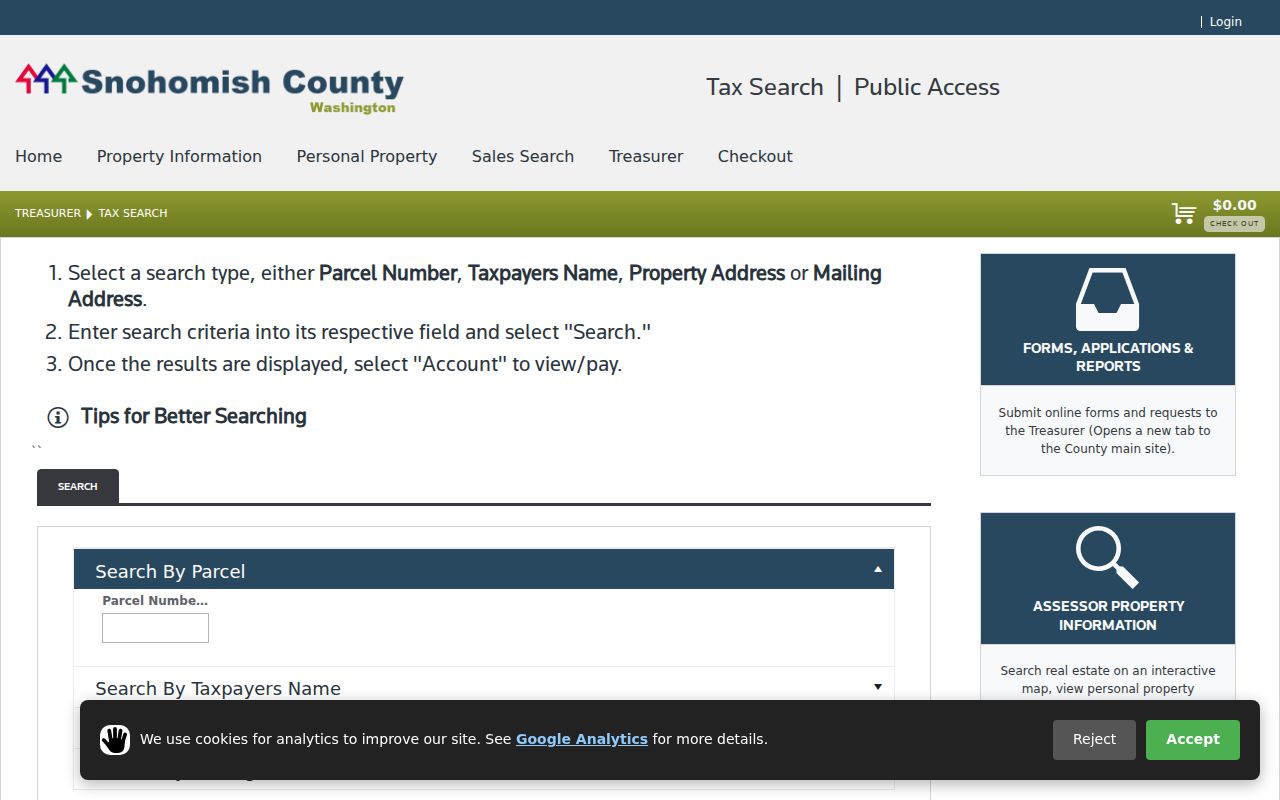
Record the selected search mode with the result. A taxpayer or mailing match can concern an owner, estate, agent, or other account relationship. It cannot be rewritten as current residence.
Mill Creek Plats Bridge Addresses
The City's residential plat maps help when a street line and legal description differ. Local additions and divisions include county recording references from before and after city incorporation. Copy the plat name, division, year, and lot or block before using Recorder legal-description fields. This can resolve older county or nearby-place labels.
Permit files take another route. Mill Creek accepts work through its permit system, but no complete public permit-history or code-case index was found. Request an existing file through OpenGov or the City Clerk under the Public Records Act, with a set address and date span. A permit name may identify an applicant or owner at that time, not every household member.
Preserve the old address form beside the current version. Historic evidence should not be silently “corrected.” Plat names often last when postal or street labels change.
Deeds Behind Mill Creek Streets
The Snohomish County Search Recorded Documents accepts name, type, ARN, date, parcel ID, book and page, and legal description. Most records since July 1976 are online. A free account has been required since March 2, 2026. Earlier deeds call for counter microfilm, staff help, phone service, or mail.
The captured gateway is the official next stop after finding a parcel.
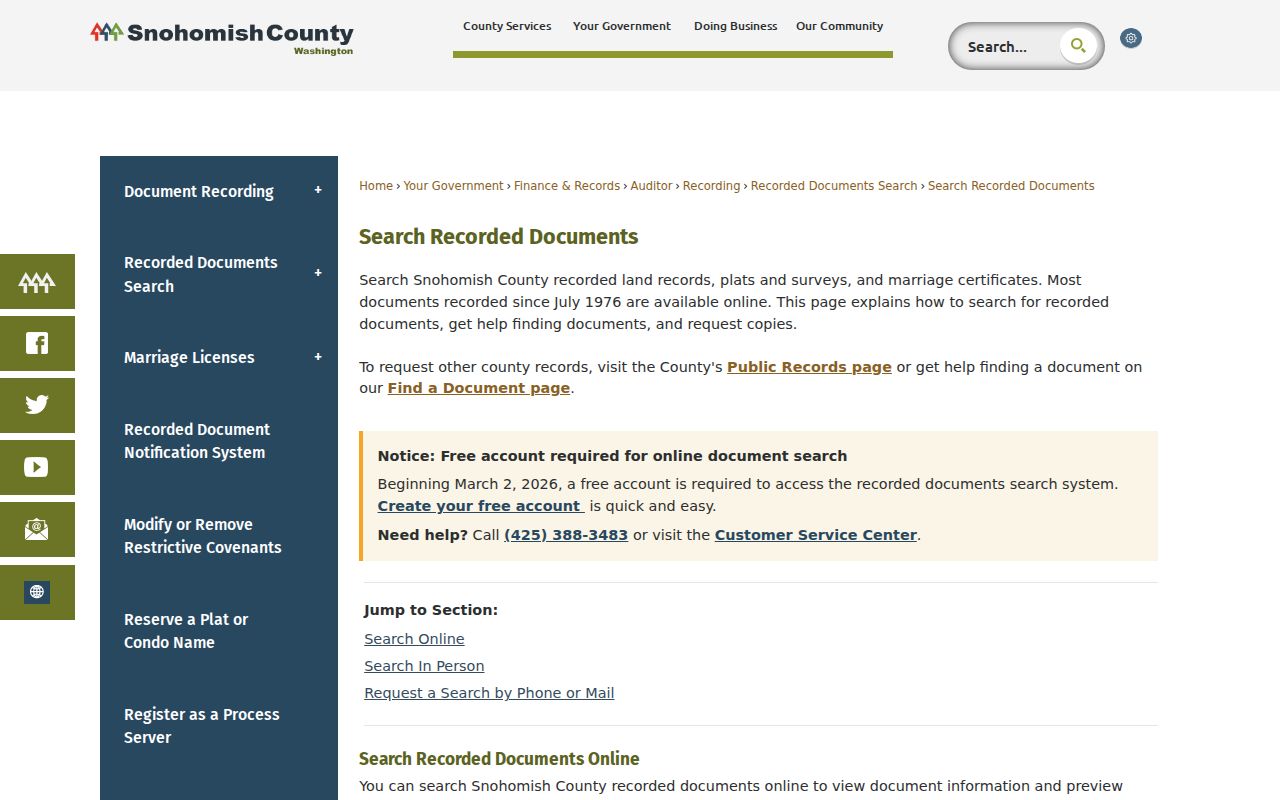
Search the first ten parcel digits, then compare party names and legal descriptions. An index hit names an instrument, not an occupant. Deeds of trust, liens, releases, reconveyances, and assignments are not all sales. Online images are unofficial; certified copies come from Recording.
The Everett counter is open Monday through Friday, 9 a.m. to 5 p.m., with 30 minutes advised before closing. Research documents $1 per page for copies and $8 per hour for significant staff or pre-1976 work. Mail requests use the Auditor Recording Division at 3000 Rockefeller Avenue, M/S 204, Everett.
Mill Creek Street Record Coverage
Each address source answers a different question. Match parcel, map, instrument, plat, and city file without turning distinct fields into an unsupported resident claim.
| Address source | Custodian | Evidence | Channels |
|---|---|---|---|
| Parcel account | County Assessor | Situs, parcel, taxpayer label, account links | Property Search and SCOPI |
| Tax account | County Treasurer | Property and mailing relationships | Tax Search |
| Instrument | Recording Division | Dated parties, ARN, type, legal description | Online, counter, mail, phone, microfilm |
| Plat or survey | Recording and City | Addition, division, lot, block | City PDFs and Recorder copies |
| Permit file | City Clerk | Existing applications and inspections | OpenGov or records request |
| Old directory | State Library and libraries | Dated name and address entries where held | Holdings, appointment, library help |
VoteWA is a personal verification tool, not an open street roster. A voter database extract requires requester details and agreement to statutory limits. Protected addresses and ballot choices are not public, and no block household list should be republished.
Date Each Mill Creek Address
Mill Creek grew as a planned community in the 1970s and incorporated in 1983. Older sources may use Snohomish County, a rural route, a nearby postal place, a school district, or plat name. County directory holdings have runs from 1882 through 2005, but the list does not promise each volume includes this area or supports address search.
No guaranteed Mill Creek reverse-directory run was verified. Ordinary directories often require browsing town and address pages. When a useful volume exists, cite its title, year, page, call number, address form, and key. The collections themselves are treated on the Mill Creek city directories page.
USPS moved 225 deliveries from 98296 to 98012 on July 19, 2008. Thus an older 98296 line can be right for its date. Keep it and add a dated normalization. Note: Directory marks such as “h” for home and “b” for boarder do not prove ownership or current occupancy.
Mill Creek Ownership Is Not Occupancy
A deed, taxpayer field, directory entry, voter address, or registered-agent address alone does not prove that a person lives at the property now. Ownership can remain after a move. Tax mail can go elsewhere. A directory captures one publication period, and voter data can lag or be protected. This is the chief myth a street directory must avoid.
Non-owner household members, utility customers, and protected residents often do not appear in the parcel chain. Describe records at the narrowest level needed for genealogy, estate research, seller checks, property history, or civic curiosity. A dated record type is more useful than a guess about a person.
Limits of Mill Creek Street Records
A street directory cannot provide a full current occupant list. Land offices track parcels and instruments, not everyone inside a home. Driver information, private utility details, confidential vital records, sealed court files, and protected voter addresses remain beyond casual address research.
The Washington Address Confidentiality Program is a hard stop. Never reverse a substitute address through parcel, voter, court, association, or archive records. An agency may cite an exemption, redirect court files, or report no responsive record. Keep that answer rather than hunting for protected data elsewhere.
Lawful use. Use Mill Creek address records only for lawful personal research. Washington law forbids stalking and harassment, and public access never permits unwanted surveillance.
For title, lien priority, or boundaries, read the recorded instrument and seek qualified advice. SCOPI's map is context, not a legal conclusion.