
Mill Creek Neighbors by Source
No official source supplies a complete household roster. The strongest block search combines the county map with account records and then keeps every finding in its proper category. Use the table to choose a source based on the exact question.
| Source | What It Shows About a Block | Access |
|---|---|---|
| SCOPI parcel map | Adjacent polygons, parcel IDs, taxpayer cards, aerials and layers | Public interactive viewer; map is illustrative |
| Assessor and Tax Search | Situs, parcel, taxpayer and tax-mailing relationships | Public address, name and parcel searches |
| Recording Division | Dated deeds, liens, plats and other parcel instruments | Most online since July 1976; older microfilm |
| City plat maps | Division, addition, lot and block context | Public City of Mill Creek PDFs |
| Voter records | Fields made public by state law | VoteWA self-check or restricted VRDB request |
| MCCA | Governance documents, meetings, budget notices and contacts | Public site; no public member directory |
| Library and archives | Old directories, photos, obituaries, school and newspaper leads | Library card, staff help or appointment |
An owner shown on a parcel card may receive tax mail elsewhere. A voter record has its own date and legal limits. An association notice proves that an institution published a notice, not that a private person belongs to it.
Map Mill Creek Neighbor Parcels
The SCOPI Interactive Map supports the adjacent-parcel method. Locate one known address, open its parcel card, and pan or zoom until the nearby boundaries are clear. Select each polygon separately. Save each parcel number, account link, map date, and active layer rather than copying names into an undated block list.
- Search the target address and confirm its parcel outline.
- Open the property account and record the situs and parcel number.
- Click each touching polygon, including parcels across the street when relevant.
- Review every “Multiple Parcels” result as separate records.
- Confirm selected accounts in Property Search or Tax Search.
SCOPI layers can add aerial dates, zoning, districts, appraisal neighborhoods, and Recent Sales. The map is a research aid, not a boundary survey. Its measure tool and polygon display do not replace a recorded plat or professional survey.
Decode Mill Creek Map Relationships
A “Multiple Parcels (Click for Info)” label describes a map relationship. It does not identify one household, one owner, or even one legal parcel. Open the group and inspect its component accounts. Shared tracts, access areas, or common interests can also make the displayed gross-acre figure larger than the exclusive residential lot.
Appraisal neighborhood codes need the same care. SCOPI's seven-digit neighborhood field groups property for valuation work. It is not an HOA name, plat division, postal neighborhood, or proof of community membership. Preserve the code as an assessor field and use the City residential plat maps when lot, block, addition, or division language is needed.
Insider tip. A plat name can bridge an unclear street address to the legal-description fields in the Snohomish County recorded-document search.
Confirm Mill Creek Neighbor Accounts
The Snohomish County Property Search accepts a parcel number or an address. Real-property parcels use 14 digits, while personal-property accounts use seven. In address mode, the house number and street name are required. Spell the street name out, use at least three characters, and omit direction or street-type terms during the first broad pass. City, state, and ZIP can then narrow candidates.
The Treasurer Tax Search adds taxpayer name, property address, mailing address, and parcel/account routes. Compare the situs address, which identifies the property location, with the mailing address used for tax correspondence. A match between them may support an owner-occupancy hypothesis, but it still does not identify every person in the home.
- Parcel
- A legally described unit of land tracked by a county number.
- Situs address
- The physical location assigned to property, distinct from a tax mailing address.
- Plat
- A recorded map dividing land into lots, blocks, roads, and common tracts.
- Appraisal neighborhood
- An assessor valuation group, not a social or HOA boundary.
Mill Creek Voter Block Limits
VoteWA is for a voter's own registration check. It asks for exact first name, exact last name, and date of birth. It is not an open screen for browsing neighbors. RCW 29A.08.710 identifies public registration fields, including name, address, jurisdiction, year of birth, voting record, registration date, and number, but the original form and other fields remain confidential.
A lawful statewide voter-database request requires the requester's name, contact details, address, county selection, and agreement to restrictions. RCW 29A.08.720 bars commercial solicitation uses. RCW 40.24 protects Address Confidentiality Program participants. The Secretary of State also announced on March 25, 2026 that statewide VRDB requests route through that office and that private fields cannot be disclosed.
Voter data is therefore a controlled public record, not a permission-free block roster. Do not republish household lists, ballot choices, exact birth dates, or protected addresses.
Mill Creek Community Directory Layer
The Mill Creek Community Association is the identifiable community association within city boundaries. Its public site offers governing documents, calendars, annual-meeting material, budgets, notices, and contact routes. Research found no public member directory. Use its contact channel to ask about boundaries, documents, or joining rules instead of inferring membership from a parcel.
| Organization or layer | Public evidence | Proper use |
|---|---|---|
| MCCA | Rules, budget, meetings, calendar, contacts | Governance research; ask association about membership |
| Planning, Park and Recreation, Youth Advisory boards | City appointments, terms and meetings | Use official public appointment records only |
| Kiwanis, Citizen Patrol, Friends of Penny Creek | Named on city volunteer pages | Treat as civic leads, not verified rosters |
| HOA rules generally | City notes that many neighborhoods have HOA rules | City code still applies; ask the relevant association |
The official MCCA homepage shows the sort of public community material available.
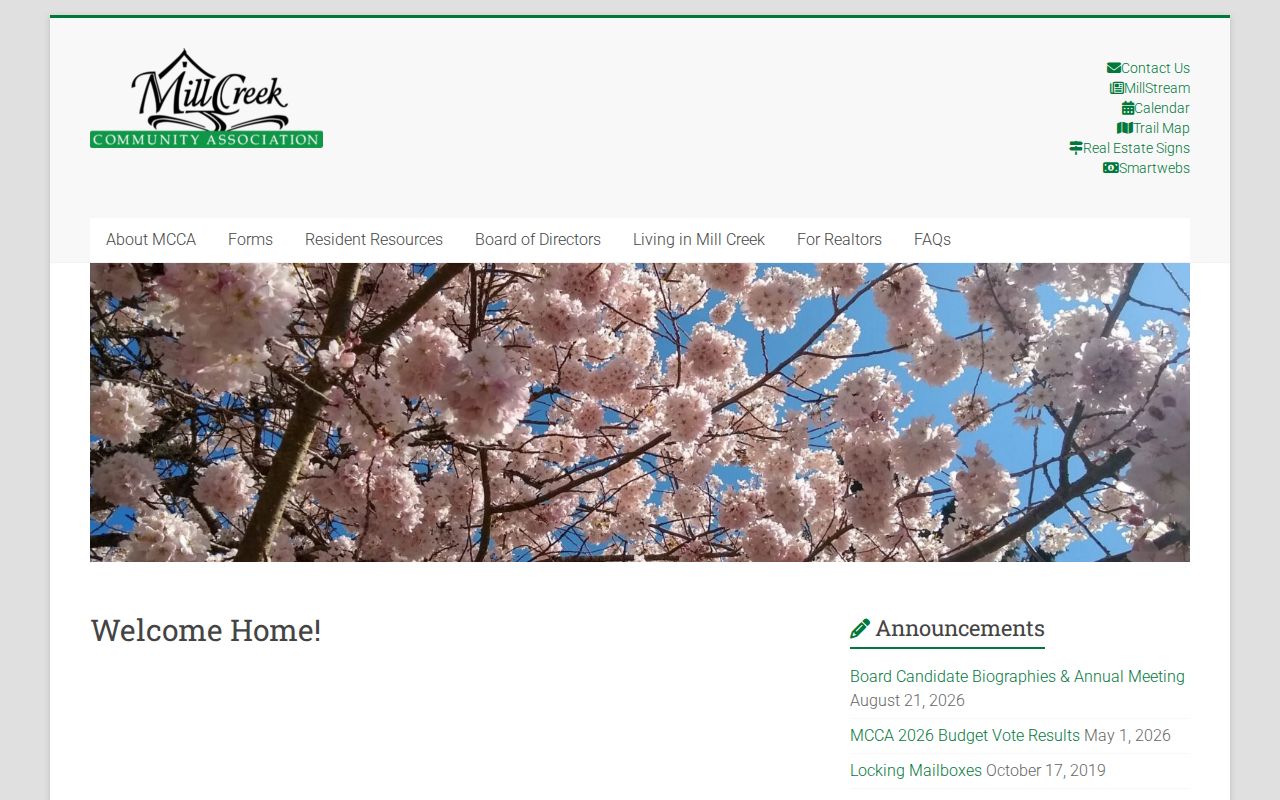
The public links support neighborhood governance research, but they do not expose a list of Mill Creek neighbors.
Mill Creek Rules Across a Block
Association covenants and city code answer different questions. The City of Mill Creek code-enforcement page notes that many neighborhoods have HOA rules, yet city code still applies. A private association may address design, landscaping, or common-area matters under its documents. The city handles its own ordinances and enforcement process.
No public citywide code-case index or street-by-street association map was found. For an existing city record, use the City Clerk or GovQA under the Washington Public Records Act. Describe the address, date range, department, and type of record. The agency must respond under its rules, but it need not create a new neighbor report or answer a general research question.
Fire, school, transit, postal, appraisal, plat, and city boundaries may cross the same block in different ways. Keep each label attached to the system that created it.
Official Mill Creek Neighbor Records
Commercial neighbor tools may merge parcel data, directories, licenses, courts, voter material, and purchased files. Their dates and address labels can be unclear. Official systems are narrower, yet they identify the custodian, record date, field meaning, access rule, and correction route.
| Question | Official record | Compiled tool category |
|---|---|---|
| Who is tied to a parcel? | Account and dated instrument state the exact role | May collapse owner, taxpayer and occupant |
| How current is it? | Search or filing date is visible | Update cycle may be unclear |
| Can it be corrected? | Named custodian has a process | Opt-out does not alter source records |
| What remains private? | Statutes and program rules control access | Coverage and suppression may vary |
The myth is simple: a deed, taxpayer field, voter address, directory entry, or agent address alone does not prove current residence. For a whole named street rather than an immediate block, use the Mill Creek by-street workflow.
Research Past Mill Creek Neighbors
Mill Creek incorporated in 1983, so older people and property records may appear under Snohomish County or another locality. The State Library's county directories, Sno-Isle property-research help, and Snohomish Historical Society collections can add old households, obituaries, photographs, title abstracts, yearbooks, school records, newspapers, and maps.
Historical directory marks also matter. An “h” or “b” may distinguish a home entry from a boarder, but neither proves ownership. Record the volume year, locality, page, street wording, household names, and abbreviation key. Compare that dated entry with a deed, census, plat, obituary, or photo rather than projecting it onto today's block.
Modern postal labels can also mislead historical work. USPS moved 225 deliveries from 98296 to 98012 on July 19, 2008. An older ZIP may be accurate for its date. Preserve it before adding a note about the later change.
Privacy for Mill Creek Neighbors
Parcel systems generally do not name every non-owner household member. Utility accounts, delivery data, private association rosters, and protected residents are not public substitutes for that gap. A block description can use parcel counts, plat names, general boundaries, and dated public roles without exposing a household's routines or private contacts.
Lawful use. Use Mill Creek neighbor records for lawful civic, historical, and personal purposes. Never use them for surveillance, unwanted contact, stalking, harassment, intimidation, or harm.
The Address Confidentiality Program is a hard stop. Do not try to reverse a substitute address through voter, parcel, court, association, or archive sources. Sealed and confidential records remain closed. When a custodian withholds a field, retain the cited rule and stop.
Note: A modest city, ZIP, plat, or parcel reference often answers the question without publishing an exact personal address.