
Mill Creek Address History Sources
The best first source depends on the period. Mill Creek incorporated in 1983, while county land and people records reach far earlier. Start with today's parcel for a modern address, use Recording for transfers, and shift to county-level indexes, printed directories, census records, and archives as the trail moves before the city's planned-community era.
| Source | Years covered | Custodian | Address-history evidence |
|---|---|---|---|
| Recorder online index | Most records since July 1976 | Snohomish County Recording Division | ARN, parties, dates, type, legal description, image |
| Older recorded instruments | Before 1976 | Everett counter and microfilm | Deed books, indexes, plats, and other instruments |
| County directories | Listed runs from 1882 through 2005 | Washington State Library | Dated address and household-style entries where included |
| 1887 census | 1887 | State Digital Archives and Library microfilm | Household, age, birthplace, occupation, and status fields |
| Federal census | Released under the 72-year rule | National Archives and library databases | Household and locality context; address detail varies |
| City records | Incorporated era from 1983 | Mill Creek City Clerk and OpenGov | Existing permit and municipal files by address |
| Historical collections | Collection-specific | Snohomish Historical Society | Photos, title abstracts, newspapers, schools, maps, obituaries |
A source's date is part of the evidence. County directory holdings have gaps and are not all digitized. A census release does not guarantee a street number. A permit can name an applicant without proving residence. Keep negative results as coverage notes rather than treating them as proof that no earlier household existed.
Past Residents Before Mill Creek
Snohomish County formed in 1861, more than a century before Mill Creek became a city. A person on land now inside Mill Creek may be indexed under the county, a rural route, Bothell or Everett vicinity, a school district, a post office, or a plat. Search the old and modern locality in separate passes. Never assume the present city name appears in an early record.
The planned community belongs mainly to the 1970s, and incorporation came in 1983. That boundary helps select records: county land, naturalization, census, and directory sources carry the earlier story; city permits and municipal files become relevant later. The absence of an online result is often a change in jurisdiction or format, not a broken chain.
USPS adds another date marker. On July 19, 2008, 225 deliveries moved from 98296 to 98012. An old 98296 address can be historically correct. Preserve its original last line, then add a dated current normalization.
Trace Snohomish County Deeds Backward
The deed chain is the ownership backbone for previous-resident research. Begin with the Snohomish County Property Search. Save the parcel ID, exact situs, current taxpayer or owner label, legal description, plat, and sales links. Then use the current Recording index to locate the newest conveyance.
- Search the parcel's first ten digits in Search Recorded Documents. Identify the latest deed or other conveyance.
- Record the ARN, date, document type, grantor, grantee, and legal description. Read the image instead of relying only on the index label.
- Search the grantor as a grantee in an earlier period. Use the addition and legal description to reject people with the same name.
- Repeat through genuine conveyances. Keep liens, deeds of trust, releases, and reconveyances in a separate instrument chain.
- When online coverage ends, use counter microfilm, staff search, phone, mail, or the Washington State Digital Archives.
- Grantor and grantee
- The grantor transfers an interest; the grantee receives it.
- Chain of title
- The sequence of recorded transfers affecting the same land.
- Legal description
- The recorded land description that can remain useful after street or postal labels change.
- ARN
- The recording number used to identify a Snohomish County instrument.
Since March 2, 2026, online document searching requires a free account. Most online coverage begins in July 1976. Significant staff or older-record research may cost $8 per hour, and the documented copy rate is $1 per page. Certified-copy pricing should be confirmed with Recording.
Mill Creek History Beyond 1976
The Snohomish Recorded Land Records collection is the historical bridge after the current portal stops. Search Party Last or Company, First, Middle, Soundex, Party Type, Keywords, Addition Name, and a year range. A related miscellaneous-recordings collection uses much the same party, addition, and year approach.
The manifest image shows the official Digital Archives collection used to extend a Mill Creek property trail.
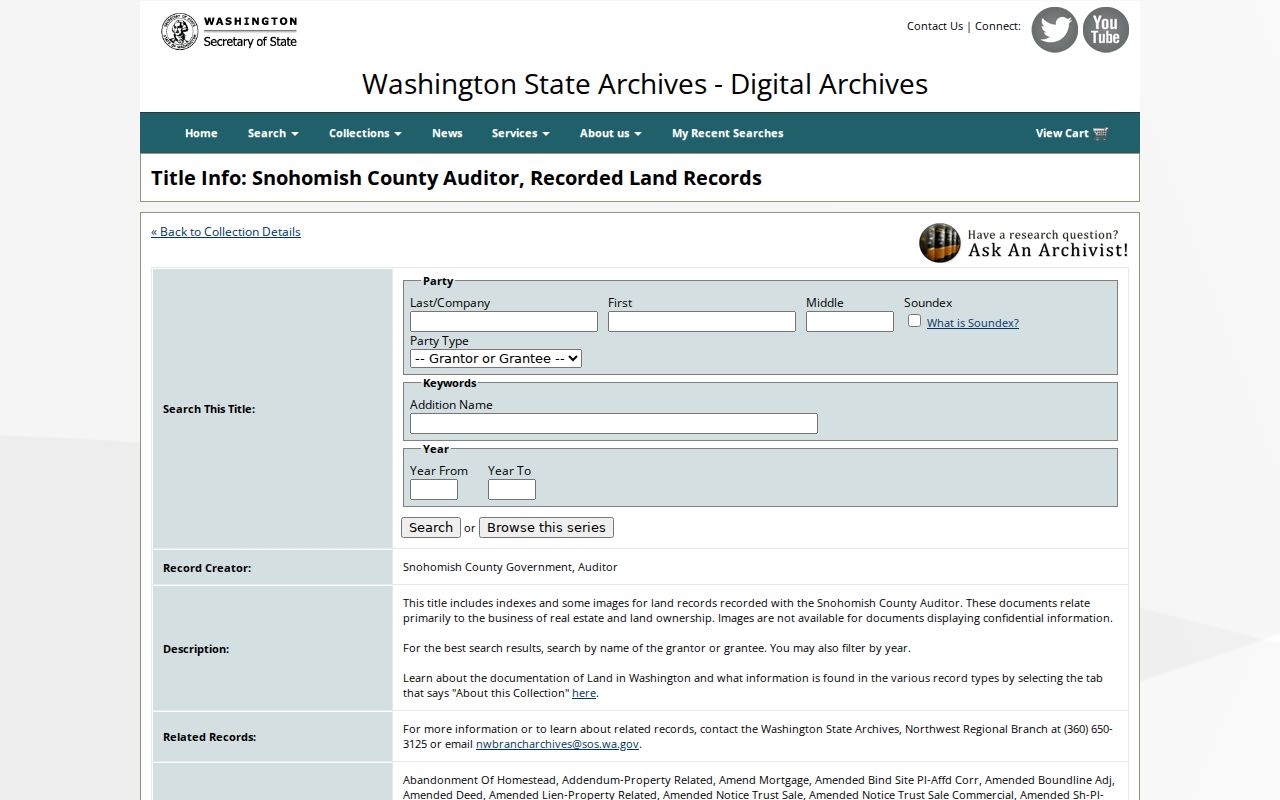
Record the collection title, party role, county, year, type, result identifier, and image indicator. No image may mean microfilm, restricted material, or a record not yet digitized. The archive index aids discovery; the current Recorder supplies certified instruments.
Insider tip. Use a City plat or addition name to bridge an unclear modern address into the historical legal-description and archive searches.
Pair Mill Creek Directories and Census
Owners are only part of an address story. A dated directory may name a householder, spouse, boarder, occupation, or business address. The 1887 Snohomish census can add household order, age, birthplace, occupation, literacy, marital status, and citizenship-era fields. Neither should be merged with a deed solely because a surname matches.
- Select the directory year closest to an ownership interval and browse the appropriate county, town, route, or address pages.
- Copy the entry as printed, including locality, page, abbreviations, and whether it marks home or boarder.
- Search the closest released census by surname, place, age, and household, allowing for incomplete address data.
- Compare date, household members, occupation, and location. Mark a probable link as probable, not certain.
- Return to deeds, probate, naturalization, or an obituary for a second independent bridge.
The State Library lists Snohomish directory runs for 1882-1887, 1901-1920, 1922-1923, 1925-1933, 1935, 1937, 1952-1982, 1984, 1992-1998, and 2000-2005. It does not claim every year is digitized or includes Mill Creek. The historical collections themselves appear on the Mill Creek city directories page.
Mill Creek House Research Help
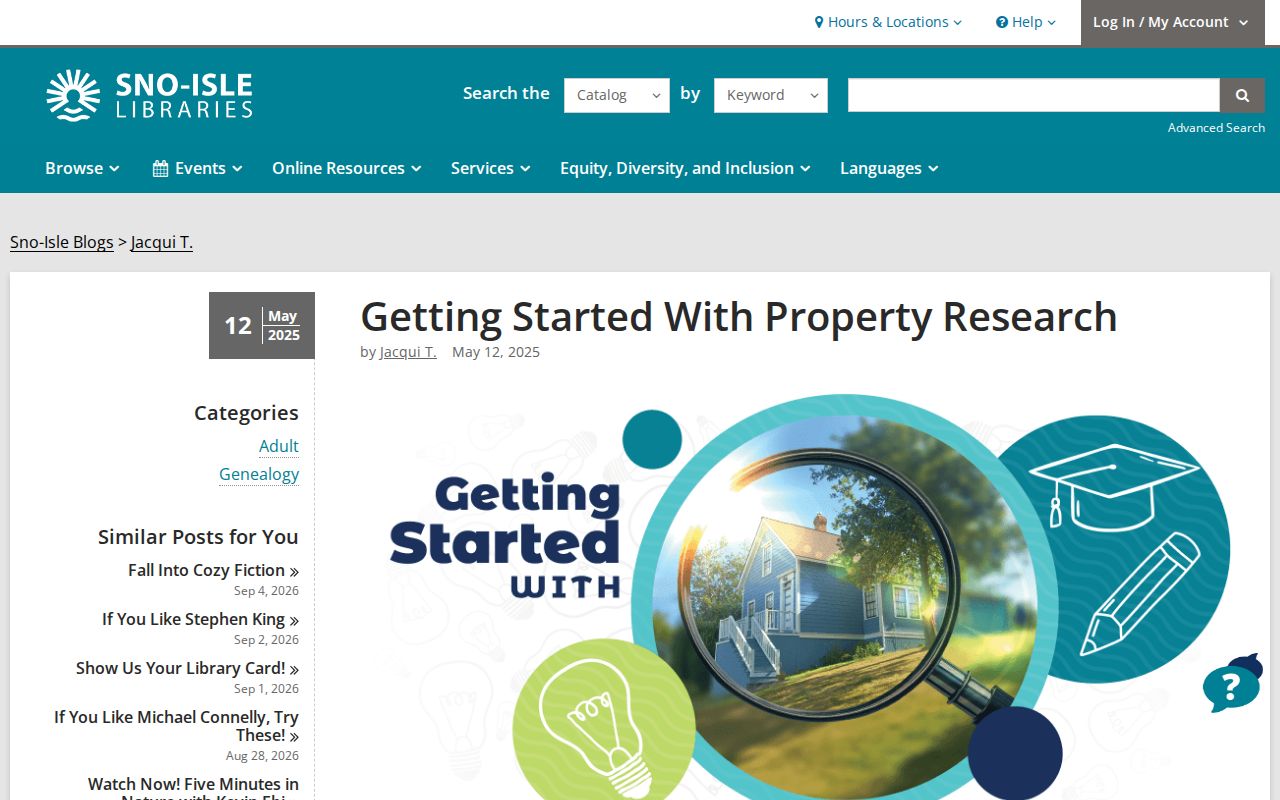
The Sno-Isle property research guide joins assessor accounts, recorded documents, historic maps, directories, census, and library help into a practical house-history method. It also warns that buildings can move or be rebuilt. A structure-age field is a lead, not a construction certificate.
The captured library guide gives past-resident research a local starting point.
Test a building date against old aerials, maps, property cards, permits, and legal descriptions. Sanborn maps may help where a sheet exists, but no Mill Creek-specific year set was verified. The Mill Creek Library also offers computers, scanning, Wi-Fi, and Book-a-Librarian help.
Close Mill Creek Household Gaps
The Snohomish Historical Society archives hold photos, newspapers, title abstracts, obituaries, maps, school and organization records, and business files. These materials can place a building or family in time when a deed and directory leave a gap. Access is collection-specific, so contact or appointment steps may apply.
Obituaries and probate can identify relatives, executors, or heirs and explain the end of an ownership interval. They do not transfer title by themselves. Use the Snohomish County Clerk for Superior Court probate files, copies, and historical access. Cite the cause number and document date where available, and respect restricted personal material.
City permit records can help distinguish construction, remodel, and replacement. No public citywide permit-history table was found. Ask the City Clerk for an existing file with a clear address and date range under Washington's Public Records Act.
Past Owners Are Not Past Residents
A deed party, taxpayer name, directory line, voter address, or probate mention alone does not prove occupancy. An owner may live elsewhere. Tax mail can go to an agent. A directory entry can be stale or mark a business, home, or boarder. This distinction is the key myth in previous-resident work.
Build two parallel timelines: one for recorded ownership and one for household evidence. Join them only when dates, place, and another identifying fact agree. Use “recorded owner,” “taxpayer label,” “directory entry,” or “possible household member” instead of the broad word resident when the source is narrower.
Use Previous Residents With Care
Previous residents research is strongest when it describes evidence rather than exposing living people. Publish city, ZIP, plat, or block context when an exact personal address is not needed. Keep full dates of birth, private contact details, protected addresses, and identity documents out of a public summary.
The Address Confidentiality Program is a hard stop. Do not try to reverse a substitute address through parcel, voter, court, association, or archive links. Sealed files, protected voter fields, and confidential vital records remain protected even when another part of an address history is public.
Lawful use. Trace Mill Creek past residents for lawful house history, genealogy, and personal research. Never use the results to track, confront, stalk, or harass a living person.
For a legal ownership or boundary issue, rely on certified instruments and qualified advice. Historical directories, maps, and memories add context, but they do not replace the recorded chain.