
Mill Creek Directory Runs
Printed city directories for the Mill Creek area belong to a Snohomish County shelf, not a neat city-only run. The Washington State Library holdings inventory lists broad groups of county volumes. Mill Creek developed as a planned community in the 1970s and incorporated in 1983, so the place label changes across that shelf. Early searches may need Bothell, Everett vicinity, a rural route, a plat name, or simply Snohomish County. Later books may include Mill Creek while leaving out a new subdivision.
| Directory collection | Years listed | Keeper | Access route |
|---|---|---|---|
| Early county directories | 1882-1887 | Washington State Library | Limited appointment research |
| Expanding county runs | 1901-1920; 1922-1923; 1925-1933; 1935; 1937 | Washington State Library | Confirm volume and format with staff |
| Postwar directories | 1952-1982; 1984 | Washington State Library | Holdings inventory, then appointment |
| Modern printed runs | 1992-1998; 2000-2005 | Washington State Library | Confirm title, locality, and call details |
| Related local-history material | Collection-specific | Sno-Isle and Snohomish Historical Society | Library service or advance archive arrangement |
The State Library county-directory page shows the official route for checking the Snohomish holdings before requesting an appointment.
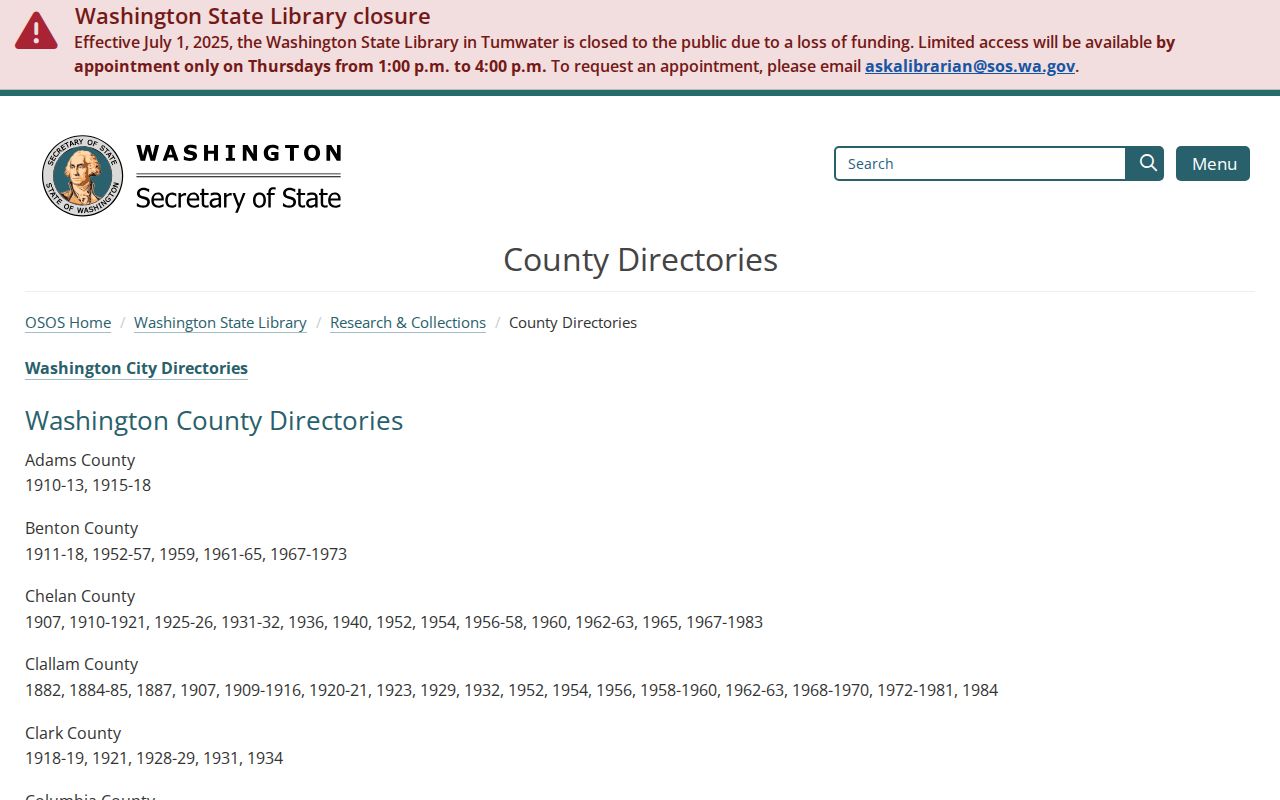
The captured holdings page is a catalog starting point. It does not establish that a specific Mill Creek address appears in any volume or that every listed year has a searchable scan.
The inventory does not say that every year is online, searchable by address, or issued by one publisher. Exact imprints were not found in the static list. Record a volume title, year, publisher line, page, institution, and scan or reel number only after inspecting the item. That practice keeps a citation honest when two volumes use different geographic scopes.
Mill Creek Before City Directories
Snohomish County was formed in 1861, more than a century before Mill Creek became a city. County land books, censuses, naturalizations, and court files therefore carry the older part of the local story. The Washington State Digital Archives groups those sources by collection and county. A search that insists on the current city name can miss a person indexed under an older precinct, school district, post office, addition, or nearby town.
| Before 1900 | Territorial census, naturalization, land, cemetery, and court collections, with incomplete indexing. |
|---|---|
| 1900s-1960s | County directories, census releases, maps, land records, and local archives. |
| 1970s | Planned-community records, plats, property files, and directories under changing place labels. |
| 1983 onward | City Clerk records join county directories, deeds, assessments, and archive sources. |
A missing city-directory line does not prove absence. Territorial censuses are intermittent, school censuses are incomplete, and printed directory coverage has long gaps. Treat “no result” as a statement about the source and spelling searched. Then try a county label and a nearby-year volume.
Mill Creek Library Research Help
The Mill Creek Library is the closest practical research desk. It is at 15429 Bothell Everett Highway and can be reached at (425) 337-4822. Regular hours are Monday through Thursday, 10 a.m. to 8 p.m.; Friday and Saturday, 10 a.m. to 6 p.m.; and Sunday, 1 to 5 p.m. Parking is noted as limited through November 2026 due to construction.
Computers, laptops, Wi-Fi, printing, copying, and scanning support a city directory search even when the useful item sits in a licensed database or another institution. Book-a-Librarian help is the best route for confirming current database access, directory titles, newspaper holdings, or an obituary source. The public branch inventory does not promise a specific Mill Creek reverse directory or newspaper reel, so ask before planning a visit around one title.
Read Mill Creek Directory Entries
A city directory entry is compact and easy to overread. The official Sno-Isle property-research example uses a 1909 Snohomish entry for the Padden family at 421 Ave A. It shows how a line may identify household members, a home or boarder mark, an occupation, widow status, and student status. It is an example of the format, not a claim about a Mill Creek resident. Always photograph or transcribe the volume key with the entry.
| Name | Surname, given name or initials, and sometimes a spouse or household relation. |
|---|---|
| Place | Street or route, plus a home, boarding, office, store, or institution context. |
| Role | Occupation, business line, widow notation, student status, or another printed label. |
| Contact | A historical telephone number where supplied, never proof of current contact. |
| Citation | Volume title, year, page, call number, scan, or reel identifier. |
- Criss-cross directory
- A directory arranged by street or phone number rather than surname. No verified Mill Creek run was found, so confirm a volume before relying on it.
- Householder index
- An address-oriented list of the person identified as the householder, not automatic proof of ownership.
- Abbreviation key
- The volume’s legend for short forms such as “h” for home and “b” for boarder.
Mill Creek Digital Archive Paths
Historical directory work becomes stronger when a printed name is tested against another dated series. The Digital Archives includes land, court, census, naturalization, vital, cemetery, property-card, corporation, and license collections. Results may show metadata without an image. An absent image can mean that the item remains on microfilm, is restricted, or has not been digitized. It does not erase the record.
The Snohomish Recorded Land Records collection provides Party Last or Company, First, Middle, Soundex, Party Type, Keywords, Addition Name, and year fields. The screenshot below shows the official collection interface used to bridge a directory name to a historic land entry.
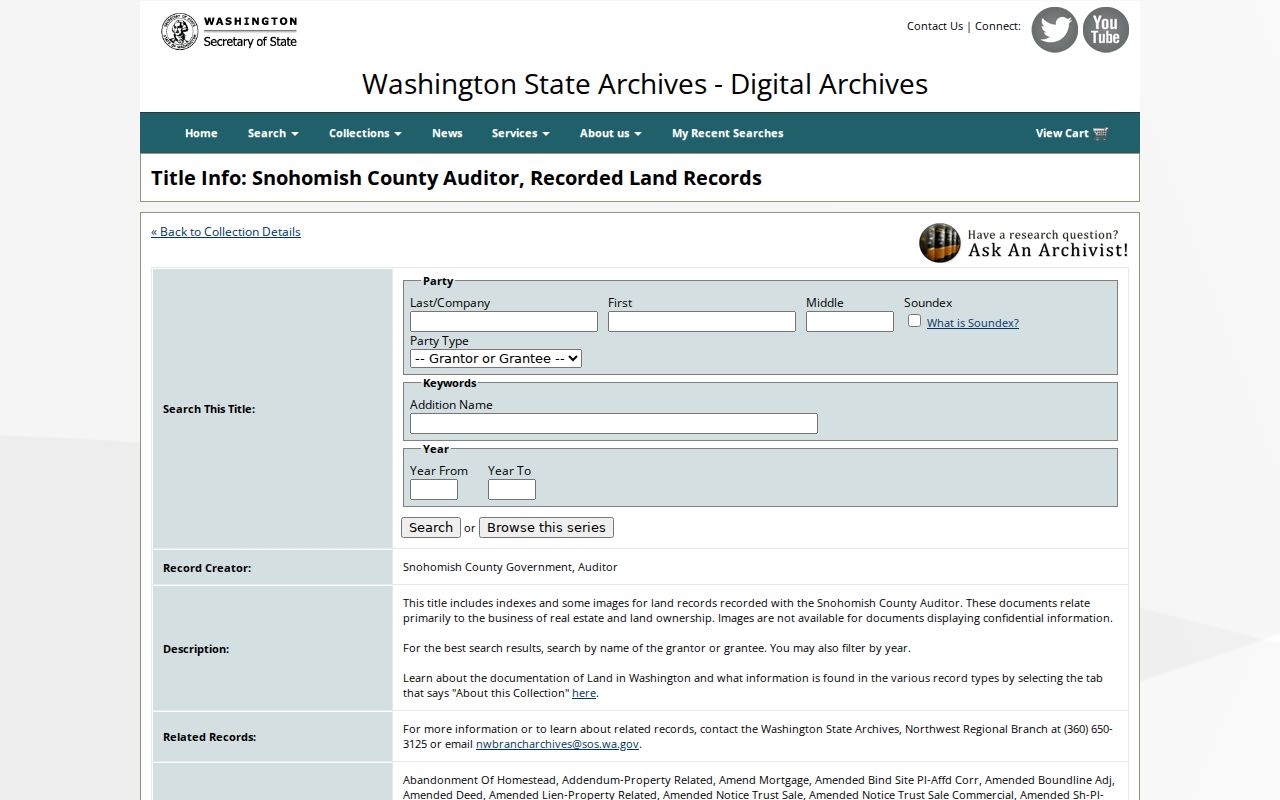
Search a surname first, then narrow by party role, addition, and year. Read the result metadata before opening any available image. For a certified copy, contact the holding Recorder, Clerk, Department of Health, or Archives channel rather than treating a research image as an official copy.
Mill Creek Directory Companion Sources
The Snohomish Historical Society archives add sources that a county directory cannot supply by itself. Holdings include photographs, account books, newspaper articles, early court records, obituaries, title abstracts, military-service material, maps, school records and yearbooks, organization files, business records, and scrapbooks. Arrange research ahead through archives@snohomishhistoricalsociety.org.
The archive image below shows the Society’s public description of its collections. It helps set expectations: this is a staffed archive with collection-level access, not an open current-resident roster.
Use a yearbook to test a school-era name, an obituary to connect relatives, or a title abstract to understand a property trail. Keep the publication, date, page, and collection citation. Organization records can document an event or institution, but they do not support guessing at private membership.
Pair Mill Creek Census Records
The 1887 Snohomish County census offers a useful bridge for people who predate modern Mill Creek city directories. Its search fields include last, first, and middle name, Soundex, birthplace, and year range. A detail can preserve household order, age, the source’s male or female category, race category, profession, marital status, birthplace, literacy, disability, and male-citizen status. The collection contains 3,133 records and notes microfilm at the State Library.
Historical labels should be transcribed as source terms and explained where needed. Do not silently modernize a category or merge two people because their names look alike. A naturalization file can help distinguish spelling variants: the Snohomish collection covers county-clerk naturalizations from 1876 through 1974.
Can a directory absence prove a move? No. A person may be unlisted, indexed under another place, missed in a gap year, or represented by initials. Census, land, naturalization, obituary, and probate evidence can explain the gap.
Trace Mill Creek Family History
A good household trail keeps each source in its own role. Printed directories show a dated appearance and the publisher’s wording. Census records add household context. Deeds name parties to recorded instruments. Obituaries may identify relatives. None should be made to prove more than it says.
- Start with the first likely surname entry. Save the title, year, page, place label, and abbreviation key.
- Check the next available city directory years in both directions. Note address, initials, spouse wording, occupation, and each gap.
- At a census year, search the county and nearby locality labels. Preserve household order and original categories.
- Use land or naturalization indexes to separate people with similar names. Compare dates and additions, not just spelling.
- Close the trail with a cited obituary, cemetery record, probate file, or vital record when access rules allow.
When the research reaches a modern address question, use the Mill Creek street directory for current parcel and address channels. Historical city directories should remain dated evidence, not be converted into a claim about who lives there now.
Mill Creek Directory Evidence Limits
A deed, taxpayer label, directory line, voter address, or registered-agent address alone does not prove that someone currently lives at a property. This is especially important in Mill Creek because a historic entry may use a rural route or neighboring postal name, while a modern parcel may use a taxpayer mailing address separate from its physical situs.
Washington’s Public Records Act governs access to many agency files, but exemptions, court rules, vital-record limits, voter restrictions, and the Address Confidentiality Program still apply. A protected or sealed record is a stop sign. Keep exact personal details out of a public research note when a city, ZIP, parcel reference, or historical block answers the question. Never use directory research for repeated unwanted contact, surveillance, harassment, or harm.